

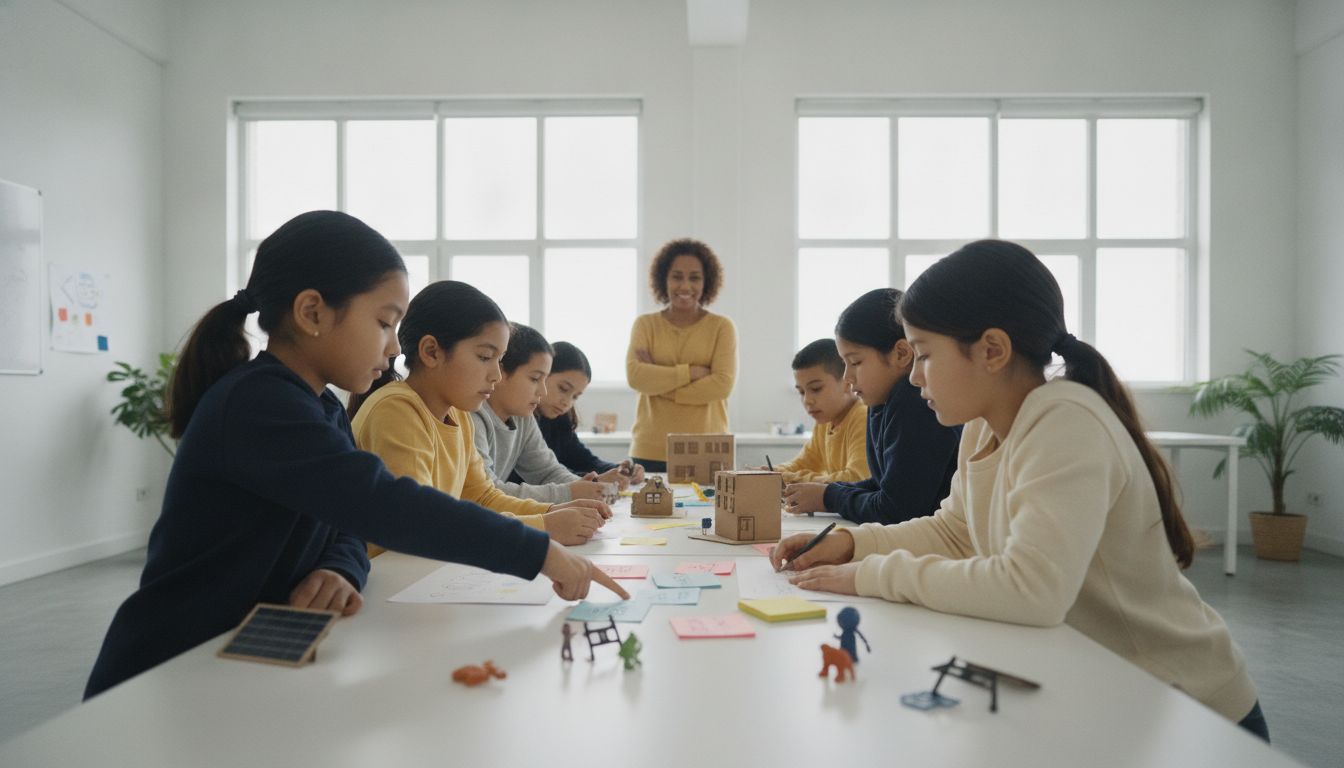
Most parents sign their children up for swimming lessons because they accept that a few swallowed mouthfuls of water are part of learning to swim. Yet when it comes to entrepreneurship, the same parents want to keep their kids in the shallow end forever. The counter-intuitive truth? The safest place to fail is while the stakes are still small.
TL;DR
- Children's brains are highly plastic, which makes childhood the best window for wiring resilience and problem-solving responses to setbacks.
- In a well-designed entrepreneurship program, failures are small, reversible, and loaded with feedback—like a product no one buys or a price that scares customers away.
- The debrief matters more than the failure itself: ask what happened, what they'd change, and what support they need.
- Adult entrepreneurs consistently trace their risk tolerance back to early, low-stakes experiences of trying, failing, and trying again.
The parenting instinct that backfires
You see your child excited about a "business idea"—homemade bracelets, a lemonade stand with a twist, a comic book subscription service. Then you also see the likely obstacles: no customers, a fight with a co-founder friend, a math mistake that wipes out the profit. Your reflex is to protect.
That reflex is understandable, but it has a side effect. When parents smooth every bump, children learn that struggle is a signal to stop rather than information to use. They become risk-averse not because they lack talent, but because they have never practiced recovering.
Entrepreneurship education flips that script. The curriculum is not "how to avoid failure." It is how to fail cheaply, decode the data, and iterate before the stakes get real.
Why young brains are built to learn from mistakes
Developmental neuroscience points to a practical advantage children have over adults: their brains are still wiring the systems that manage uncertainty, frustration, and recovery. Every time a child encounters a mismatch between expectation and result—"I thought this would sell, but it didn't"—the brain has a chance to update its mental model.
That update process is the foundation of resilience. In childhood, the prefrontal cortex is under construction, which means coping strategies and problem-solving habits become hardwired more easily than they do later in life. A small failure handled well today becomes a neural shortcut for handling bigger setbacks tomorrow.
This is why structured entrepreneurship programs for kids do not wait until participants are "ready." They create contained failure experiences deliberately, while a facilitator is present to guide the debrief.
Key insight
Resilience is not a personality trait kids are born with. It is a practiced response to discrepancy: I expected X, I got Y, now what?
What productive failure looks like in practice
In a kids' entrepreneurship program, failure is not a red mark on a report card. It is a feedback loop with three features: it is low-stakes, it is tied to a decision the child made, and it leads to a clear next experiment.
Here are examples that happen almost every session:
The product no one buys
A child spends an hour building a glitter-keychain empire. At the pop-up market, no one stops. The failure feels personal until the facilitator reframes it: "You built something. Now you have data on what this audience does not want." The next step is customer interviews, not tears.
The pricing mistake
A team sells out in ten minutes and realizes they charged half of what they should have. Instead of a lecture on math, they calculate the loss together, adjust the price, and run a second batch. They learn cost, margin, and demand in one afternoon.
The pitch that flops
A nervous founder reads from a script and forgets the price. The audience looks confused. Afterward, the group identifies one thing to change—maybe a visual prop or an opening question—and tries again. Public speaking becomes a skill to adjust, not an identity to fear.
The team conflict
Two co-founders disagree on who gets to be "CEO." The project stalls. Facilitators treat this as a real business moment: clarify roles, split responsibilities by strength, and write a simple agreement. Conflict becomes negotiation practice.
"Failure is not the opposite of success. It is the information success feeds on."
How to debrief without toxic positivity or harsh criticism
The failure itself teaches very little. The learning happens in the conversation afterward. Most parents swing between two unhelpful extremes: "It's fine, you did great!" or "What did you expect? You didn't prepare." Neither gives the child a path forward.
A better approach is a three-question debrief:
- What happened? Stick to facts. No blame, no cheerleading. "You priced the item at $2 and sold out in five minutes."
- What would you try differently? Let the child generate the adjustment. Ownership is the point.
- What do you need from me? Sometimes they want help. Sometimes they just want you to listen. Ask and then follow their lead.
What to avoid
- Toxic positivity: "Everything happens for a reason" or "You were perfect!" strips the experience of its lesson.
- Premature rescue: Fixing the problem for them teaches dependence, not resourcefulness.
- Over-analysis: A ten-minute lecture turns a learning moment into a performance review.
The long game: why early failure tolerance predicts adult success
Ask adult entrepreneurs about their first business and most will not describe a triumph. They will describe a lemonade stand that lost money, a garage invention that broke, a school venture that no one funded. What they remember is not the outcome. They remember that they survived it and tried again.
That pattern matters. Entrepreneurship is not a talent for being right the first time. It is a tolerance for being wrong repeatedly while staying in motion. The earlier children experience this rhythm—attempt, feedback, adjustment—the more natural it feels when the stakes are higher: college applications, first jobs, real pitches.
Children who learn to treat failure as data do not become reckless. They become calculated risk-takers: people who can spot when a setback is temporary, when a pivot is smarter than persistence, and when the real failure is refusing to start.
FAQ
Won't failure hurt my child's self-esteem?
Not when it is small, expected, and followed by a debrief. Self-esteem is damaged by shame or repeated helplessness, not by a prototype that flops in a safe workshop setting. The key is how adults frame the failure afterward.
What counts as a "productive" failure in a kids' business program?
A failure is productive when it produces actionable information: a product no one buys reveals a mismatch with the audience; a pricing mistake reveals cost math; a pitch that falls flat reveals messaging gaps. The lesson must be visible and reversible.
How should I talk to my child after a setback?
Skip both toxic positivity and a post-mortem lecture. Ask three questions: What happened? What would you try differently? What do you need from me? Then let them lead the next step.
At what age can children start learning from failure in entrepreneurship?
Children as young as seven or eight can grasp cause-and-effect in a business context, especially with concrete tools like prototypes, price tags, and customer feedback. The framing matters more than the age.
How is failure built into MLBB programs?
Our programs design low-stakes launch cycles where kids build, test, and iterate. Failure is treated as expected data, not a grade. You can see the full learning design on our programs page.
The best time to let your child fail is before a real investor, customer, or boss is watching. Explore our programs and see how we turn setbacks into the most valuable lessons.


