

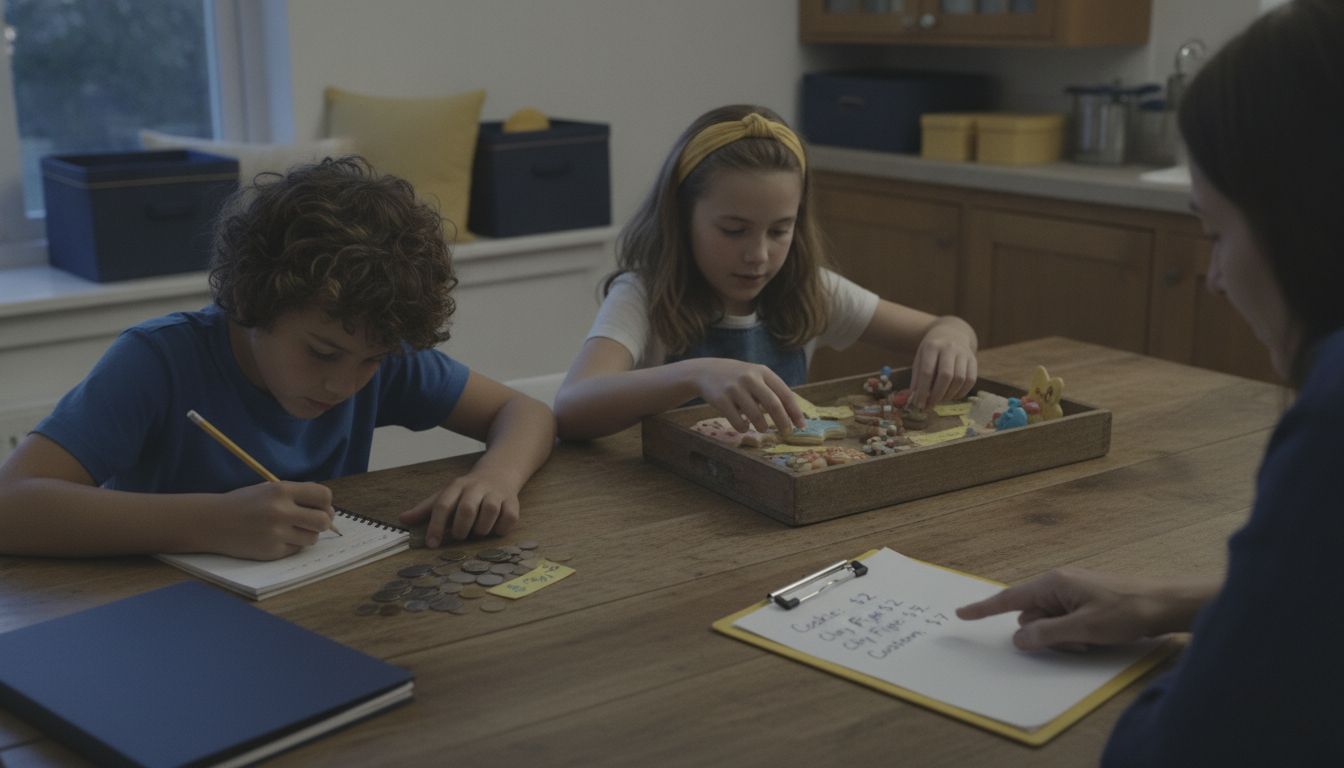
Teaching Financial Literacy Through Kid-Friendly Business Projects
Allowance charts teach kids that money appears weekly. Business projects teach them that money has to be earned, spent wisely, and sometimes lost. If you want children to understand finance, give them a real customer, a real product, and a real decision to make.
TL;DR — The quickest takeaways
- Match the project to the age. Service businesses suit younger kids, product businesses suit tweens, and digital content fits confident early teens.
- Let them handle real money concepts. Cost of goods sold, pricing, profit margin, and saving land harder when the cash is theirs.
- Track only three numbers at first. Cost per unit, sale price, and running profit keep the lesson simple.
- Let small failures happen. A $5 loss at ten is far cheaper than a $500 mistake at twenty.
- Move to a structured program when they outgrow the kitchen table. Cohorts, mentors, and real markets multiply the learning.
Why allowance charts rarely stick
Most parents have watched a child receive allowance on Monday and have nothing left by Wednesday. The problem is not impulse control. The problem is that the money had no story attached. It did not require a trade-off, a customer, or a consequence.
A business project fixes this because the money is earned in public. The child has to decide what to charge, whether to buy better materials, and what to do when a neighbor says the price is too high. Those moments are the curriculum.
Three project archetypes by age
1. Service-based projects — ages 7 to 10
Service businesses are the easiest entry point because they require almost no inventory. A child can walk dogs, wash cars, water plants, rake leaves, or read aloud to a younger neighbor. The product is time and attention, which means the math is simple.
Best first lessons: how many hours a task takes, what a customer will pay for that time, and why showing up on time matters. If a job takes two hours and pays $10, the child learns the value of an hour faster than any worksheet can explain it.
Starter project: A “Saturday car wash” with one family car at a set price. The child supplies soap, a bucket, and labor. Afterward, calculate what the soap cost and what remains as profit.
2. Product-based projects — ages 9 to 13
Product businesses add the challenge of materials, waste, and pricing. Baking cookies, making greeting cards, assembling snack boxes, or printing custom stickers all force a child to spend money before making money.
Best first lessons: cost of goods sold, pricing strategy, profit margin, and inventory. A child who bakes cookies learns that flour is cheap but stickers and packaging are not, and that one broken cookie still counts as a cost.
Starter project: A weekend bake sale with one item, one price, and one location. Track every ingredient cost, then ask: “How many do we need to sell to cover costs and pay yourself?”
3. Digital content projects — ages 11 to 15
Older kids can create once and sell repeatedly. A drawing becomes a printable, a tutorial becomes a short video, a Notion template becomes a downloadable product. These projects teach scale, platform fees, royalties, and reinvestment.
Best first lessons: digital overhead, platform commissions, and the time-value of creating an asset. They also learn that “passive income” still requires upfront work and marketing.
Starter project: Design a simple printable planner or sticker sheet, list it on a family-approved platform, and track views, sales, fees, and net profit.
The four financial concepts that matter most
Every project can embed the same four ideas. The trick is to introduce them through action, not lectures.
Cost of goods sold
Help your child list every cost required to make one sale. For cookies, that means flour, sugar, eggs, chocolate chips, packaging, and any printed labels. For a car wash, it means soap and sponge wear. For a printable, it means the design tool subscription or platform listing fee.
The insight: revenue is not profit. If you sell a $3 cookie but spent $1.20 making it, you have $1.80 left, not $3.
Pricing strategy
Ask your child to set the first price. Resist the urge to correct it immediately. If they underprice, they will feel the pain of working hard for little reward. If they overprice, they will learn about customer resistance.
Explain two simple models: cost-plus pricing (add a margin on top of costs) and value-based pricing (what is the customer willing to pay because of convenience or quality). Most kids should start with cost-plus because it is concrete.
Profit margin
Once they know revenue and cost, show them the margin. A 40% margin means $4 profit on every $10 sale. Make it visible: color the “cost” portion of a bar one color and the “profit” portion another. When children see margin shrink because of a fancy packaging upgrade, they suddenly understand trade-offs.
Saving and reinvestment
Split profits into clear buckets: spend, save, give, and reinvest. A simple rule of thumb is 40% spend, 20% save, 10% give, 30% reinvest. Adjust based on your family values, but keep the split visible and physical.
Reinvestment is the most underrated lesson. When a child uses part of this month’s profit to buy better ingredients or a nicer sign, they learn that businesses grow by delaying gratification.
Tracking tools that do not overwhelm
You do not need accounting software. In fact, starting on paper is often better because it makes money feel real. The goal is to create a habit, not a spreadsheet wizard.
Start with three numbers
Track only these at first:
- Cost per unit — what it costs to make one item or do one job.
- Sale price — what one customer pays.
- Running profit — total money in minus total money out.
Paper, spreadsheet, or app?
- A notebook ledger works for ages 7 to 11. Columns for date, money in, money out, and balance. The act of writing slows spending down.
- A simple spreadsheet fits ages 10 and up. One row per sale, one row per cost. Let the child type the formulas after you show them once.
- A family banking app like Greenlight, GoHenry, or FamZoo is useful if your child already has one. Use it to separate business money from spending money, not to replace the ledger.
The 10-minute weekly money review
Once a week, spend ten minutes looking at the numbers together. Ask: What sold best? What cost more than expected? What should we try differently next week? This meeting is more important than any single lesson.
Let them fail small
This is the hardest part for parents. You will see the mistake coming. A child will price lemonade at $0.25 per cup, spend $15 on supplies, and end with $4. Your instinct will be to quietly cover the loss. Don’t.
Controlled failure is the entire point. The child feels the consequence, adjusts the price or the recipe, and tries again. The loss is small, the feedback is immediate, and the memory lasts.
Debrief questions after a flop:
- What did you expect to happen?
- Which number surprised you — cost, price, or sales?
- What is one thing you would change?
- Do you want to try again, or pivot to a different idea?
If you do lend money for a restart, write down the repayment terms. Interest is optional, but the obligation should be real. Children who pay back a loan from their own profit suddenly understand why capital has a cost.
When a structured program adds value
DIY projects at home are powerful. They are also limited by your time, your network, and your patience. A structured entrepreneurship program becomes useful when a child outgrows the kitchen table.
Signs your child is ready for more:
- They stick with a project for more than a few weeks.
- They start asking about better tools, bigger customers, or real marketplaces.
- They get frustrated by feedback only from family members.
- They want a peer group that takes their business seriously.
A good program provides curriculum, mentorship, accountability, and access to real audiences. It turns a one-off weekend sale into a repeatable learning cycle. For parents looking for that next step, Kids' Entrepreneurship & Leadership Courses offer structured frameworks, mentor feedback, and market events where children test their ideas outside the family bubble.
Frequently asked questions
What age is too young to start a business project?
Most children can begin around age 5 or 6 as helpers on a family project. By 7, they can run simple service businesses. Product businesses fit well from 9 onward, and digital content projects typically work best from 11 up.
Should I pay for supplies or make my child invest their own money?
Treat startup supplies like a real investment. Offer a small loan or matching contribution, and have your child pay it back from first sales. That makes the cost of goods sold tangible and gives them ownership of the outcome.
How do I keep this from becoming another homework battle?
Cap the project time, let your child choose the idea, and connect the math to something they care about. It should feel like an activity, not an assignment. If enthusiasm drops, shrink the scope rather than forcing completion.
What if my child wants to quit after their first failure?
Normalize the failure. Ask what they expected, what actually happened, and what one variable they would change. Offer one restart with that adjustment. If they still want to quit, let them, but require a short post-mortem so the lesson sticks.
Do kids need a real bank account for this?
Not at first. A clear jar or envelope system works for younger children. Older kids can use a sub-account inside a family banking app so they see digital balances and transfers without needing their own account.
Start with one customer
Financial literacy is not a vocabulary test. It is the habit of making decisions with limited resources and living with the results. The fastest way to teach it is to hand your child a real product, a real price tag, and a real customer.
Start small. One item. One sale. One spreadsheet row. The lessons will compound from there.
Ready to move beyond the kitchen table? Explore Kids' Entrepreneurship & Leadership Courses for structured programs that help kids turn ideas into real businesses.


